Recipe archive · Giovedì gnocchi · Bread, memory and technique
Aline, una cucina intelligente prima che sostenibile
Questa pagina nasce da una vecchia lezione privata con Aline, una mia allieva brasiliana. In quegli anni, quando avevo la mia scuola di cucina in Italia, tenevo una lezione che si chiamava, molto semplicemente, Giovedì gnocchi. Era una di quelle lezioni apparentemente facili, quasi rassicuranti, ma in realtà molto serie: si partiva da una parola familiare, “gnocchi”, e si finiva dentro una parte enorme della cucina italiana.
Gli gnocchi non sono solo quelli di patate. Anzi, gli gnocchi di patate sono arrivati tardi. Prima ci sono stati impasti di farina, pane, acqua bollente, brodo, formaggio, uova, spezie. C’erano gnocchi più poveri e gnocchi ricchissimi, gnocchi da servire con burro e formaggio, ma anche con sughi di carne, cacciagione, spezie dolci e profumi che oggi useremmo con molta più cautela: noce moscata, macis, pepe, a volte cannella.
Durante quella lezione cercavo di far capire le grandi famiglie tecniche degli gnocchi. Da una parte gli gnocchi di patate, dove lavora l’amido della patata cotta e la farina deve intervenire il meno possibile. Da un’altra gli gnocchi alla parigina, che sono una pasta choux salata: liquido a bollore, farina cotta nel liquido, massa asciugata, poi uova, formatura e cottura. Poi ci sono i canederli, altra famiglia ancora: pane raffermo ammollato, latte, uova, erbe, speck o formaggio, e una forma più grande, più alpina, più vicina al mondo del Knödel.
Questi invece sono gnocchi di pane in un senso diverso. Non sono canederli piccoli. Non sono pane bagnato e tenuto insieme alla meglio. Sono una massa di pane raffermo cotta in acqua bollente speziata, una specie di panade povera e antica. Il pane vecchio non viene semplicemente ammorbidito: viene trasformato. L’acqua bollente riattiva l’amido del pane, lo compatta, lo rende una base lavorabile. Solo dopo, quando la massa si è asciugata, entra la farina, non per costruire l’impasto da zero, ma per rifinirlo e permettere la formatura.
Per questo li trovo ancora molto attuali. Oggi parleremmo di recupero, riuso, cucina sostenibile. Ma questa non è una sostenibilità dichiarata a parole. È una cucina che sa cosa fare con il pane avanzato. Il pane non viene buttato, ma nemmeno nascosto. Diventa materia prima, tecnica, memoria.
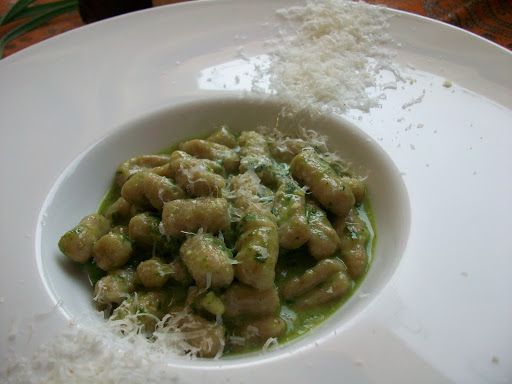
Aline fece questa fotografia. Il condimento, in quel caso, era un pesto alla genovese: una scelta moderna, fresca, quasi in contrasto con l’anima più antica dello gnocco. Ma il centro della lezione non era il pesto. Era lo gnocco: capire che dentro una parola semplice ci sono secoli di cucina, famiglie diverse, errori possibili, mani diverse.
Nota tecnica: qui il punto non è ammollare il pane, ma cuocerlo. La farina arriva dopo e deve restare una correzione, non diventare la struttura principale.
Gnocchi di pane cotti in acqua speziata
Ingredienti per 4 persone
- 300 g pane raffermo, meglio se sbriciolato o grattugiato grossolanamente
- 450 g acqua o brodo leggero, con altri 50–100 g da tenere pronti solo se il pane assorbe troppo in fretta
- sale, da regolare secondo la sapidità del pane
- noce moscata
- macis, facoltativo ma molto adatto a questa famiglia di sapori
- pepe bianco, facoltativo
- 1 uovo
- 60–100 g farina, solo quanto basta per rendere lavorabile l’impasto
- 30 g formaggio stagionato grattugiato, Parmigiano Reggiano, pecorino o una miscela dei due
Sull’acqua: partirei da 450 g. Se il pane è molto secco o molto compatto, si può salire verso 500–550 g. Non deve però restare una pappa bagnata: la massa va cotta e asciugata, come una polenta dura o una choux povera.
Preparazione
- Portare a bollore l’acqua o il brodo con sale, noce moscata e, se si usa, macis e pepe bianco.
- Aggiungere il pane raffermo sbriciolato o grattugiato.
- Mescolare con energia. All’inizio sembrerà una massa irregolare, poi il pane comincerà ad assorbire il liquido.
- Cuocere continuando a mescolare, finché il composto diventa compatto, denso e abbastanza asciutto. Deve ricordare una polentina dura o la fase iniziale di una pasta choux.
- Trasferire la massa in una ciotola o su un piano e lasciarla intiepidire.
- Unire l’uovo e il formaggio grattugiato.
- Aggiungere la farina poco alla volta. Fermarsi appena l’impasto diventa lavorabile. La quantità dipende dal pane e da quanta umidità è rimasta.
- Formare piccoli gnocchi. Si possono lisciare semplicemente o passare leggermente su una forchetta o su una tavoletta rigata.
- Cuocere prima uno gnocco di prova in acqua salata appena bollente. Se tiene, procedere. Se si apre, aggiungere poca farina o pangrattato e riprovare.
- Cuocere gli gnocchi in acqua salata non troppo violenta. Quando salgono, aspettare poco e scolarli con delicatezza.
Condimento: pesto alla genovese
In quella lezione gli gnocchi furono serviti con un pesto alla genovese. Non è l’unico condimento possibile: questi gnocchi reggono bene burro e salvia, sughi di carne, fondi di cacciagione, formaggi, erbe amare. Il pesto però crea un contrasto interessante: una base antica, di pane cotto e spezie, con una salsa fredda, verde, ligure, viva.
Pesto più intenso
- 60 g basilico fresco
- 1 spicchio d’aglio piccolo
- 25 g pinoli
- 50 g Parmigiano Reggiano grattugiato
- 20 g pecorino stagionato
- 90–110 g olio extravergine d’oliva delicato
- sale marino
Pesto più morbido
- 60 g basilico fresco
- mezzo spicchio d’aglio, oppure aglio appena strofinato nel mortaio
- 35 g pinoli
- 45 g Parmigiano Reggiano grattugiato
- 10–15 g pecorino
- 110–130 g olio extravergine d’oliva delicato
- sale marino
Metodo
- Asciugare molto bene il basilico.
- Pestare aglio e sale nel mortaio, oppure frullare a impulsi brevi.
- Aggiungere pinoli e basilico senza scaldare la salsa.
- Unire i formaggi.
- Incorporare l’olio poco alla volta.
- Condire gli gnocchi fuori dal fuoco, sciogliendo il pesto con poca acqua di cottura.
Aline, intelligent cooking before it was called sustainable
This page comes from an old private lesson with Aline, a Brazilian student of mine. At that time, when I had my cooking school in Italy, I used to teach a class called, very simply, Giovedì gnocchi — Thursday gnocchi. It sounded like an easy, almost comforting class, but it was actually one of the most serious ones. We started from a familiar word, “gnocchi”, and ended up inside a large part of Italian food culture.
Gnocchi are not only potato gnocchi. Potato gnocchi arrived relatively late. Before them there were doughs made with flour, bread, boiling water, broth, cheese, eggs and spices. Some were poor, some were rich. Some were served with butter and cheese, others with meat sauces, game, sweet spices and aromas that today we would use much more carefully: nutmeg, mace, pepper, sometimes cinnamon.
In that class I wanted students to understand the main technical families of gnocchi. There are potato gnocchi, where the starch of the cooked potato does most of the work and flour should stay under control. There are gnocchi alla parigina, made from a savoury choux pastry: boiling liquid, flour cooked into the liquid, the dough dried in the pan, then eggs, shaping and cooking. And then there are canederli, which belong to another family: stale bread soaked in milk, mixed with eggs, herbs, speck or cheese, shaped into larger dumplings, closer to the Alpine world of Knödel.
These are bread gnocchi in a different sense. They are not small canederli. They are not simply soaked bread held together with flour. They are made from stale bread cooked in boiling spiced water, a kind of poor and ancient panade. The bread is not just softened: it is transformed. The boiling water reactivates the starch in the bread, compacts it and turns it into a workable base. Flour comes later, not to build the dough from zero, but to finish it and make shaping possible.
This is why I still find them so contemporary. Today we would talk about reuse, low waste, sustainable cooking. But this is not sustainability as a slogan. It is a kitchen that knows what to do with leftover bread. The bread is not thrown away, but it is not hidden either. It becomes ingredient, technique, memory.
Aline took this photograph. In that lesson the sauce was a Genovese pesto: a modern, fresh choice, almost in contrast with the older soul of the gnocchi. But the point of the lesson was not the pesto. It was the gnocchi: understanding that inside a simple word there are centuries of cooking, different families, possible mistakes, and different hands.
Technical note: the point here is not to soak the bread, but to cook it. Flour comes later and should remain a correction, not the main structure.
Bread gnocchi cooked in spiced water
Ingredients for 4 people
- 300 g stale bread, crumbled or roughly grated
- 450 g water or light broth, with another 50–100 g ready only if the bread absorbs too quickly
- salt, depending on how salty the bread is
- nutmeg
- mace, optional but very suitable here
- white pepper, optional
- 1 egg
- 60–100 g flour, only as much as needed to make the dough workable
- 30 g grated aged cheese, Parmigiano Reggiano, pecorino or a mix of both
About the water: I would start with 450 g. If the bread is very dry or very compact, you can move towards 500–550 g. But the final dough must not stay wet: it has to be cooked and dried, like a very firm polenta or a poor choux pastry.
Method
- Bring the water or broth to the boil with salt, nutmeg and, if using them, mace and white pepper.
- Add the stale bread, crumbled or roughly grated.
- Stir vigorously. At first it will look irregular, then the bread will begin to absorb the liquid.
- Cook while stirring until the mixture becomes compact, dense and fairly dry. It should resemble a firm polenta or the first stage of a choux pastry.
- Transfer the mass to a bowl or work surface and let it cool slightly.
- Add the egg and grated cheese.
- Add the flour little by little. Stop as soon as the dough becomes workable. The exact amount depends on the bread and on how much moisture remains.
- Shape small gnocchi. They can be left smooth or lightly rolled on a fork or gnocchi board.
- Cook one test gnocco first in gently boiling salted water. If it holds, continue. If it opens, add a little flour or breadcrumbs and test again.
- Cook the gnocchi in salted water, not too violently boiling. When they rise to the surface, wait briefly and lift them out gently.
Sauce: Genovese pesto
In that lesson the gnocchi were served with Genovese pesto. It is not the only possible sauce: these gnocchi also work with butter and sage, meat sauces, game reductions, cheese, bitter herbs. Pesto, however, creates an interesting contrast: an ancient base of cooked bread and spices, with a cold, green, Ligurian sauce.
More intense pesto
- 60 g fresh basil
- 1 small garlic clove
- 25 g pine nuts
- 50 g grated Parmigiano Reggiano
- 20 g aged pecorino
- 90–110 g delicate extra virgin olive oil
- sea salt
Softer pesto
- 60 g fresh basil
- half a garlic clove, or just a garlic-rubbed mortar
- 35 g pine nuts
- 45 g grated Parmigiano Reggiano
- 10–15 g pecorino
- 110–130 g delicate extra virgin olive oil
- sea salt
Method
- Dry the basil very well.
- Crush garlic and salt in a mortar, or blend in short pulses.
- Add pine nuts and basil without heating the sauce.
- Add the cheeses.
- Incorporate the olive oil slowly.
- Dress the gnocchi off the heat, loosening the pesto with a little cooking water.
Aline, kluge Küche, bevor man sie nachhaltig nannte
Diese Seite entstand aus einem alten privaten Kochkurs mit Aline, einer brasilianischen Schülerin von mir. Damals, als ich meine Kochschule in Italien hatte, gab es eine Lektion, die ich ganz einfach Giovedì gnocchi nannte — Donnerstag Gnocchi. Das klang leicht, fast harmlos, war aber in Wahrheit eine sehr ernste Lektion. Man begann mit einem vertrauten Wort, “Gnocchi”, und landete mitten in einem großen Teil der italienischen Kochkultur.
Gnocchi sind nicht nur Kartoffelgnocchi. Kartoffelgnocchi kamen relativ spät. Vorher gab es Teige aus Mehl, Brot, kochendem Wasser, Brühe, Käse, Eiern und Gewürzen. Manche waren einfach, andere sehr reich. Manche wurden mit Butter und Käse serviert, andere mit Fleischsaucen, Wild, süßen Gewürzen und Aromen, die wir heute viel vorsichtiger verwenden würden: Muskatnuss, Macis, Pfeffer, manchmal Zimt.
In dieser Lektion wollte ich die großen technischen Familien der Gnocchi zeigen. Es gibt Kartoffelgnocchi, bei denen die Stärke der gekochten Kartoffel die Hauptarbeit macht und Mehl nur vorsichtig eingesetzt werden sollte. Es gibt Gnocchi alla parigina, aus einem salzigen Brandteig: kochende Flüssigkeit, Mehl in die Flüssigkeit einarbeiten, die Masse im Topf trocknen, dann Eier, Formen und Garen. Und dann gibt es Canederli, wieder eine andere Familie: altbackenes Brot, in Milch eingeweicht, mit Eiern, Kräutern, Speck oder Käse gemischt und als größere Knödel gekocht.
Diese hier sind Brotgnocchi in einem anderen Sinn. Sie sind keine kleinen Canederli. Sie sind nicht einfach eingeweichtes Brot, das irgendwie mit Mehl zusammengehalten wird. Sie entstehen aus altbackenem Brot, das in kochendem, gewürztem Wasser gekocht wird: eine arme und alte Art von Panade. Das Brot wird nicht nur weich gemacht, sondern verwandelt. Das kochende Wasser aktiviert die Stärke im Brot, verdichtet sie und macht daraus eine formbare Masse. Das Mehl kommt erst danach: nicht um den Teig zu bauen, sondern um ihn zu vollenden.
Genau deshalb finde ich sie heute noch interessant. Heute würden wir von Resteverwertung, Low Waste oder nachhaltiger Küche sprechen. Aber das ist keine Nachhaltigkeit als Etikett. Es ist eine Küche, die weiß, was man mit altem Brot macht. Das Brot wird nicht weggeworfen, aber auch nicht versteckt. Es wird Zutat, Technik, Erinnerung.
Aline machte dieses Foto. In dieser Lektion wurden die Gnocchi mit Pesto alla genovese serviert: eine moderne, frische Wahl, fast im Gegensatz zur älteren Seele der Gnocchi. Aber das Zentrum der Lektion war nicht das Pesto. Es waren die Gnocchi: zu verstehen, dass in einem einfachen Wort Jahrhunderte von Küche stecken, verschiedene Familien, mögliche Fehler und verschiedene Hände.
Technische Notiz: Hier geht es nicht darum, Brot einzuweichen, sondern es zu kochen. Das Mehl kommt danach und soll nur korrigieren, nicht die Hauptstruktur bilden.
Brotgnocchi in gewürztem Wasser gekocht
Zutaten für 4 Personen
- 300 g altbackenes Brot, zerbröselt oder grob gerieben
- 450 g Wasser oder leichte Brühe, zusätzlich 50–100 g bereithalten, falls das Brot sehr schnell aufnimmt
- Salz, je nachdem wie salzig das Brot ist
- Muskatnuss
- Macis, optional, aber hier sehr passend
- weißer Pfeffer, optional
- 1 Ei
- 60–100 g Mehl, nur so viel wie nötig, um die Masse formbar zu machen
- 30 g geriebener gereifter Käse, Parmigiano Reggiano, Pecorino oder eine Mischung aus beiden
Zum Wasser: Ich würde mit 450 g beginnen. Wenn das Brot sehr trocken oder sehr kompakt ist, kann man auf 500–550 g gehen. Die fertige Masse darf aber nicht nass bleiben: Sie muss gekocht und getrocknet werden, wie eine feste Polenta oder ein armer Brandteig.
Zubereitung
- Wasser oder Brühe mit Salz, Muskatnuss und, wenn verwendet, Macis und weißem Pfeffer zum Kochen bringen.
- Das zerbröselte oder grob geriebene altbackene Brot zugeben.
- Kräftig rühren. Am Anfang wirkt die Masse unregelmäßig, dann beginnt das Brot, die Flüssigkeit aufzunehmen.
- Unter Rühren kochen, bis die Masse kompakt, dicht und relativ trocken wird. Sie soll an eine feste Polenta oder die erste Phase eines Brandteigs erinnern.
- Die Masse in eine Schüssel oder auf eine Arbeitsfläche geben und etwas abkühlen lassen.
- Ei und geriebenen Käse einarbeiten.
- Das Mehl nach und nach zugeben. Aufhören, sobald der Teig formbar ist. Die Menge hängt vom Brot und von der Restfeuchtigkeit ab.
- Kleine Gnocchi formen. Sie können glatt bleiben oder leicht über eine Gabel oder ein Gnocchibrett gerollt werden.
- Zuerst einen Probe-Gnocco in leicht kochendem Salzwasser garen. Wenn er hält, weitermachen. Wenn er zerfällt, wenig Mehl oder Semmelbrösel einarbeiten und erneut testen.
- Die Gnocchi in Salzwasser garen, das nicht zu stark kocht. Wenn sie an die Oberfläche steigen, kurz warten und vorsichtig herausheben.
Sauce: Pesto alla genovese
In dieser Lektion wurden die Gnocchi mit Pesto alla genovese serviert. Das ist nicht die einzige Möglichkeit: Diese Gnocchi funktionieren auch mit Butter und Salbei, Fleischsaucen, Wildjus, Käse oder bitteren Kräutern. Pesto gibt aber einen interessanten Kontrast: eine alte Basis aus gekochtem Brot und Gewürzen mit einer kalten, grünen, ligurischen Sauce.
Kräftigeres Pesto
- 60 g frisches Basilikum
- 1 kleine Knoblauchzehe
- 25 g Pinienkerne
- 50 g geriebener Parmigiano Reggiano
- 20 g gereifter Pecorino
- 90–110 g mildes natives Olivenöl extra
- Meersalz
Weicheres Pesto
- 60 g frisches Basilikum
- eine halbe Knoblauchzehe, oder nur ein mit Knoblauch ausgeriebener Mörser
- 35 g Pinienkerne
- 45 g geriebener Parmigiano Reggiano
- 10–15 g Pecorino
- 110–130 g mildes natives Olivenöl extra
- Meersalz
Zubereitung
- Das Basilikum sehr gut trocknen.
- Knoblauch und Salz im Mörser zerreiben oder sehr kurz im Mixer pulsieren.
- Pinienkerne und Basilikum zugeben, ohne die Sauce zu erwärmen.
- Den Käse einarbeiten.
- Das Olivenöl langsam einfließen lassen.
- Die Gnocchi nicht in der Pfanne mit dem Pesto erhitzen, sondern das Pesto mit etwas Kochwasser lösen und außerhalb der Hitze verwenden.