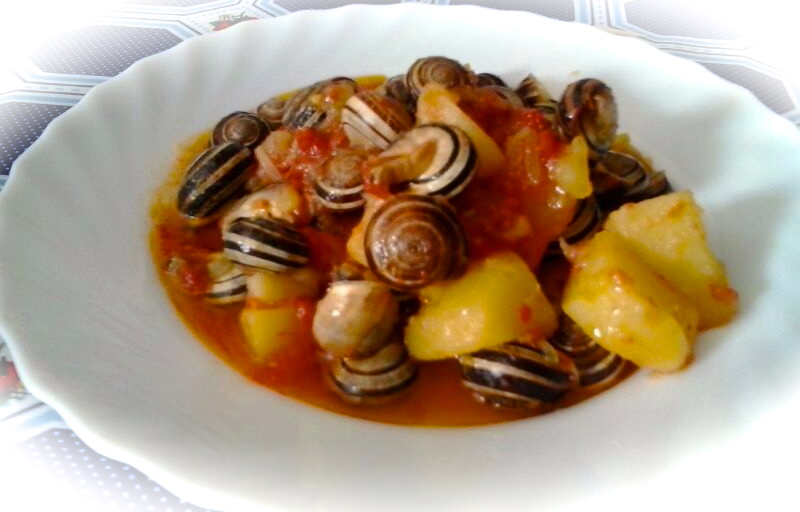
Ciammaruche con patate di zia Filomena, detta Ninuccia
Una ricetta di famiglia campana che conserva un modo di cucinare lento, domestico e concreto: lumache, patate, pomodoro, aglio, prezzemolo e peperoncino. Un piatto senza scorciatoie, costruito sul tempo.
L’ingrediente più lento che ci sia.
Questa pagina conserva una ricetta legata a una famiglia campana e a zia Filomena, detta Ninuccia. Le “ciammaruche” — le lumache — appartengono a quella cucina popolare capace di trasformare ingredienti semplici in piatti profondamente identitari.
Nei secoli le lumache sono passate continuamente da cibo povero a boccone ricercato, da ingrediente contadino a preparazione da tavola importante. Qui non hanno bisogno di essere nobilitate: restano dentro una ricetta familiare, con patate, pomodoro, aglio, prezzemolo e peperoncino.
Il tempo è parte della ricetta: prima le lumache, poi il fondo, il vino, il pomodoro e infine le patate. Il piatto è pronto quando tutto si tiene insieme senza perdere la propria consistenza.
Per 4 persone
Ingredienti principali
- Lumache per uso alimentare800 g
- Patate400 g
- Pomodori pelati450 g
- Olio extravergine d’oliva100 ml
- Prezzemolo1 mazzetto
- Aglio3 spicchi
- Peperoncino1
- Vino bianco secco1 bicchiere
- Salequanto basta
Per la prima cottura delle lumache
- Cipolla1 piccola
- Sedano1 costa
- Alloro1 foglia
- Aglio2 dei 3 spicchi totali
- Acqua e salequanto basta
Preparazione
- Lava accuratamente le lumache già spurgate.
- Metti le lumache in abbondante acqua salata con cipolla, sedano, una foglia di alloro e 2 spicchi d’aglio. Portale a cottura, quindi scolale e tienile da parte.
- In un tegame basso, preferibilmente di coccio, versa l’olio extravergine d’oliva. Aggiungi il restante spicchio d’aglio, parte del prezzemolo e il peperoncino, tutto tritato finemente.
- Quando il fondo comincia appena a prendere colore, aggiungi le lumache già bollite e falle insaporire per qualche istante.
- Sfuma con un bicchiere di vino bianco secco e lascia evaporare completamente l’alcol.
- Aggiungi i pomodori pelati, schiacciandoli leggermente. Copri e lascia cuocere dolcemente per circa 30 minuti.
- Taglia le patate in pezzi regolari e aggiungile al tegame.
- Versa acqua tiepida fino quasi a coprire il contenuto. Regola di sale e prosegui la cottura per circa 15 minuti, o fino a quando le patate saranno cotte ma ancora compatte.
- Controlla sapidità e consistenza del fondo. Il piatto deve risultare umido e legato, non acquoso.
- Completa con prezzemolo fresco tritato e servi caldo.
Perché conservarla
Ricette come questa hanno valore proprio perché non nascono da una costruzione contemporanea. Sono cucina domestica, familiare e territoriale. Metterle in archivio significa conservare non soltanto una lista di ingredienti, ma un lessico: “ciammaruche”, il tegame di coccio, il fondo di aglio e prezzemolo, le patate aggiunte alla fine.
Versione editoriale aggiornata nel 2026 a partire dalla ricetta storica pubblicata sul sito Andrea Sposini. La struttura della ricetta, gli ingredienti e il carattere familiare del piatto sono stati mantenuti; la forma è stata resa più leggibile e trilingue.
Zia Filomena’s “ciammaruche” with potatoes
A Campanian family recipe built around one of the slowest ingredients in the kitchen: snails, cooked with potatoes, tomato, garlic, parsley and chilli. A domestic dish in which time is part of the flavour.
The slowest ingredient there is.
This page preserves a recipe connected to a Campanian family and to zia Filomena, known as Ninuccia. “Ciammaruche” — snails — belong to that popular cooking tradition capable of turning simple ingredients into deeply recognisable food.
Across history, snails have moved constantly between rustic food and refined delicacy. Here they do not need to be elevated: they remain inside a family dish with potatoes, tomato, garlic, parsley and chilli.
Time is part of the recipe: first the snails, then the aromatic base, wine and tomato, and finally the potatoes. The dish is ready when everything comes together without losing its texture.
Serves 4
Main ingredients
- Food-grade snails800 g
- Potatoes400 g
- Peeled tomatoes450 g
- Extra-virgin olive oil100 ml
- Parsley1 bunch
- Garlic3 cloves
- Chilli1
- Dry white wine1 glass
- Saltas needed
For the first cooking of the snails
- Onion1 small
- Celery1 stalk
- Bay leaf1
- Garlic2 of the 3 cloves above
- Water and saltas needed
Preparation
- Wash the already purged snails thoroughly.
- Place them in plenty of salted water with onion, celery, bay leaf and 2 cloves of garlic. Cook, then drain and reserve.
- In a low pan — traditionally earthenware — heat the extra-virgin olive oil with the remaining garlic clove, part of the parsley and the chilli, all finely chopped.
- As soon as the aromatic base begins to colour lightly, add the cooked snails and sauté briefly.
- Deglaze with a glass of dry white wine and let the alcohol evaporate completely.
- Add the peeled tomatoes, crushing them lightly. Cover and cook gently for about 30 minutes.
- Cut the potatoes into even pieces and add them to the pan.
- Add warm water until the contents are almost covered. Season with salt and cook for about 15 minutes, or until the potatoes are cooked but still hold their shape.
- Check seasoning and the consistency of the sauce. It should be moist and bound, not watery.
- Finish with freshly chopped parsley and serve hot.
Why keep this recipe
Recipes like this matter precisely because they were not designed as contemporary concepts. They belong to domestic, family and regional cooking. Archiving them preserves not only ingredients, but vocabulary, gestures and a way of organising a meal.
„Ciammaruche“ mit Kartoffeln von Zia Filomena, genannt Ninuccia
Ein kampanisches Familienrezept rund um eine der langsamsten Zutaten der Küche: Schnecken mit Kartoffeln, Tomaten, Knoblauch, Petersilie und Chili. Ein häusliches Gericht, bei dem Zeit Teil des Geschmacks ist.
Die langsamste Zutat, die es gibt.
Diese Seite bewahrt ein Rezept aus einer kampanischen Familie und erinnert an Zia Filomena, genannt Ninuccia. „Ciammaruche“ — Schnecken — gehören zu jener Alltagsküche, die aus einfachen Zutaten Gerichte mit starker Identität macht.
Historisch schwankte die Wahrnehmung von Schnecken immer wieder zwischen bäuerlichem Essen und raffinierter Delikatesse. Hier müssen sie nicht veredelt werden: Sie bleiben Teil eines Familiengerichts mit Kartoffeln, Tomaten, Knoblauch, Petersilie und Chili.
Zeit gehört zum Rezept: zuerst die Schnecken, dann der aromatische Ansatz, Wein und Tomaten und erst zum Schluss die Kartoffeln. Fertig ist das Gericht, wenn alles zusammenhält, ohne seine Struktur zu verlieren.
Für 4 Personen
Hauptzutaten
- Schnecken für den Lebensmittelverzehr800 g
- Kartoffeln400 g
- Geschälte Tomaten450 g
- Natives Olivenöl extra100 ml
- Petersilie1 Bund
- Knoblauch3 Zehen
- Chili1
- Trockener Weißwein1 Glas
- Salznach Bedarf
Für das erste Garen der Schnecken
- Zwiebel1 kleine
- Sellerie1 Stange
- Lorbeer1 Blatt
- Knoblauch2 der 3 Zehen
- Wasser und Salznach Bedarf
Zubereitung
- Die bereits vorbereiteten Schnecken gründlich waschen.
- In reichlich Salzwasser mit Zwiebel, Sellerie, Lorbeer und 2 Knoblauchzehen garen. Anschließend abgießen und beiseitestellen.
- In einem flachen Topf — traditionell aus Ton — Olivenöl mit der restlichen Knoblauchzehe, einem Teil der Petersilie und Chili erhitzen; alles fein gehackt.
- Sobald der Ansatz leicht Farbe annimmt, die vorgegarten Schnecken zugeben und kurz anbraten.
- Mit einem Glas trockenem Weißwein ablöschen und den Alkohol vollständig verdampfen lassen.
- Geschälte Tomaten zugeben und leicht zerdrücken. Abdecken und etwa 30 Minuten sanft garen.
- Kartoffeln in gleichmäßige Stücke schneiden und in den Topf geben.
- Warmes Wasser zugeben, bis der Inhalt fast bedeckt ist. Salzen und etwa 15 Minuten weitergaren, bis die Kartoffeln weich, aber noch kompakt sind.
- Abschmecken und die Konsistenz prüfen. Der Sud soll gebunden und saftig, aber nicht wässrig sein.
- Mit frisch gehackter Petersilie abschließen und heiß servieren.
Warum dieses Rezept bewahren
Solche Rezepte sind gerade deshalb wertvoll, weil sie nicht als modernes Konzept entstanden sind. Sie gehören zur häuslichen, familiären und regionalen Küche. Ihr Archiv bewahrt nicht nur Zutaten, sondern auch Begriffe, Gesten und eine bestimmte Art, Essen zu organisieren.